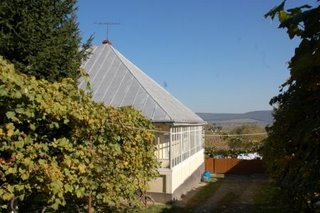
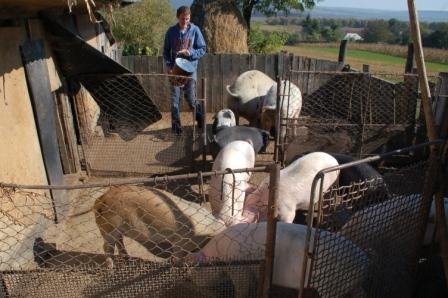
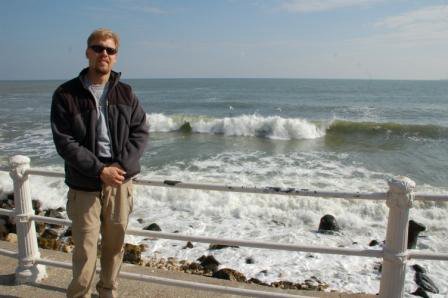
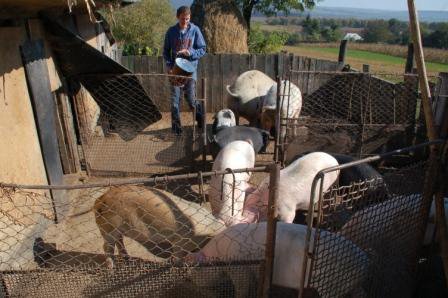
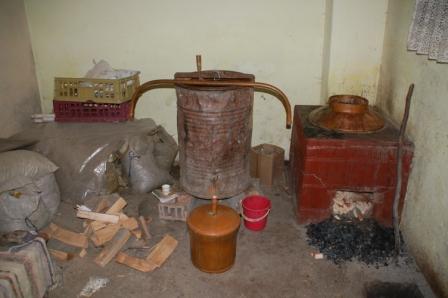
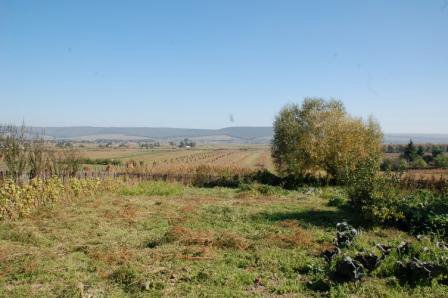
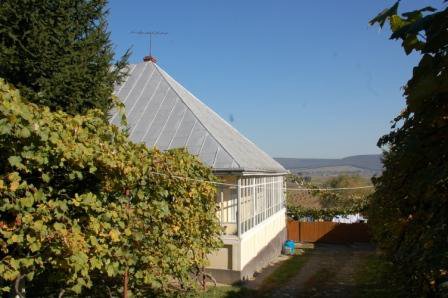
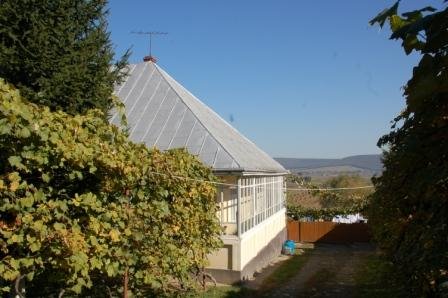
Well my friends, this update is so packed with sites seen & blessed experiences that I might break it up into two segments...Wow, I'm still dumbstruck (and no that's not dumb blond, all though I'm sure many of you had a good laugh about it... :) with how to begin about Romania. You must come see & experience it before they join the EU in the next 5 years and suffer the same consequences that most of the rest of Europe has, economically, culturally, etc. I have been truly touched by my experience here and would say that it has been life changing, to be cliche'. I have been overwhelmed by the sincerity, generosity, and faith of the people. I have spent the last two weeks in Moldavia, the northeastern state of Romania, bordering Ukraine & the Republic of Moldova. Some have called this land the northern Athos because of the deep faith and piety of the people and sheer number of churches and monasteries. Two of the largest in the world are here, Varatec & Agapia, both with over 400 nuns! This land reminds me of where I grew up, with its simple and natural way of life that my parents and grandparents enjoyed, living off of the land, growing most of their own food or raising animals, where the village was a family. It has been enriching to spend this time with people who are living their faith in their every day life. For example, a simple farmer was telling us the story about how he was so surprised to have run into a large snake in the forest that day (after the feast of the Cross--Sept. 14), when the snakes were supposed to flee & go back into the ground until after winter. There are still struggles here though, against poverty and the lack of jobs, remains of communism, and the new traps of western materialism under the new "freedom". Now, to understand their Orthodoxy, one must understand their history. They are regionally located in the middle of the "Oriental" & "Occidental", roughly between Greece and Russia geographically, and culturally have roots from Rome, Byzantium, and the Slavs. It is the only Orthodox nation using a Latin language. Also, they have a significant Gypsy population that has been assimilated better than in most countries and even ascribe to Orthodoxy. I toured regionally in Moldavia, first to the Bucovina region then to Neamt, so I'll cover the sites regionally/chronologically. I must also apologize in advance for the butchering of any translated names from Romanian into English....
Iasi County
City of Iasi

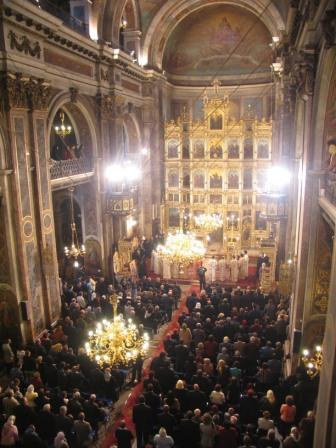
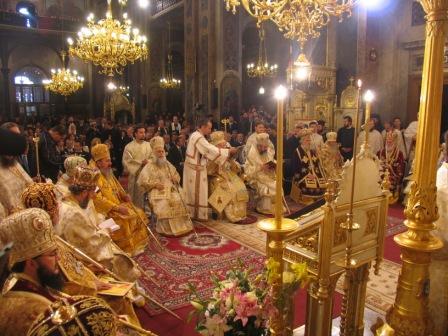
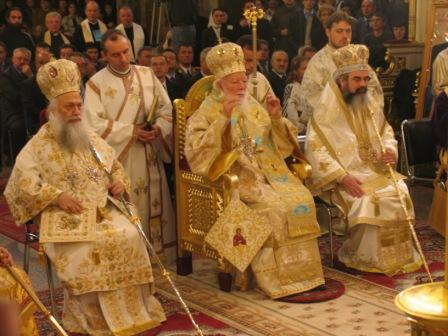
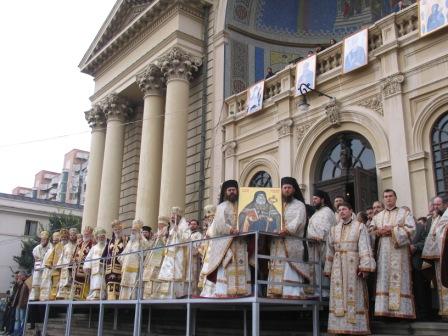
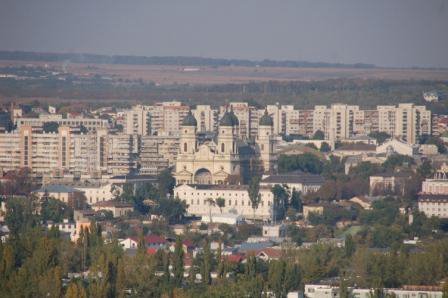
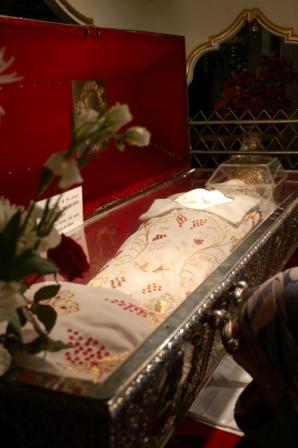
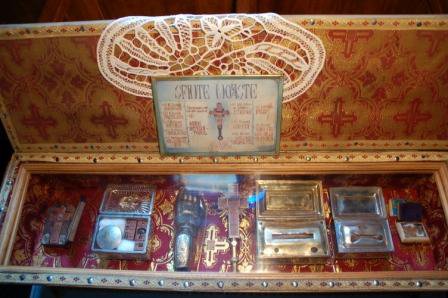
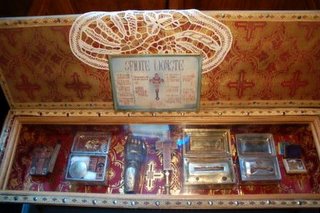
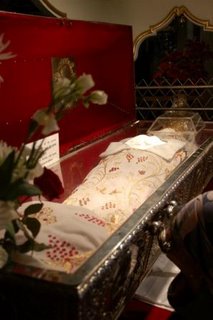 I arrived in Iasi, the city where the relics of St. Parascheva the New reside, the patron of Moldavia. Her miracle working relics reside in the Metropolitan's cathedral (since 1641) and were given to the ruler Basil Lupu as a gift by the Patriarch of Constantinople for paying Patriarchates annual tribute to the Turks who were occupying much of the old Byzantine Empire at this time. This was my first place to venerate and witness the piety of the Romanian people. The cathedral has a constant stream of pilgrims year round to pray and venerate her relics. We arrived in the middle of a prayer service to the saint and waited at least half an hour in line to venerate her fragrant relics. Besides her holy relics they also had a box containing the relics of several saints available for veneration (Apostles Mark, Philip, Bartholomew & Barnabas; Dionysios the Areopagite; Gregory the Theologian; Athanasios the Great; John the Merciful; Modestos; Epiphanios; Stephen the First Martyr; Great Martyr George; John the New of Suceava; Tryphon; Theodore Stratelates; Haralampos; Tyron; Holy 40 Martyrs of Sebaste; Panteleimon; Artemie; Great Martyr Menas; Antipas the Roman; Varnava; Efthymios; Kyriake; Parascheva (the patron of the Texas womens' monastery); Permagon; the Martyrs of Crete; Martyrs of St. Savvas in Israel; John Cassian; Herman of Alaska; Veil of the Theotokos & Belt of the Theotokos (Mary, Mother of God). We also went to Golia Monastery, in the middle of city, where the men orchestrate the Cultural Missionary Institute "Trinitas" with publishing efforts and a radio station broadcasted across most of Romania. I was fortunate to be able to meet and speak with the abbot Fr. Vitale, one of the elders at the cathedral Fr. Constantine, and run into some friends from Holy Archangels who were also pilgrimaging.
Suceava County (Bucovina Region)
Probota Monastery 
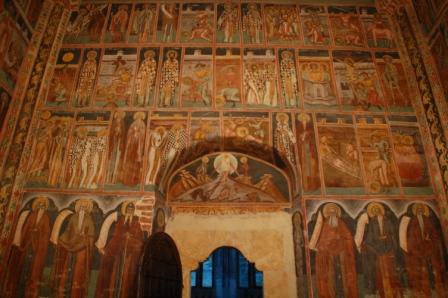
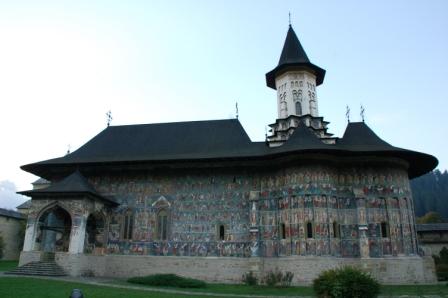
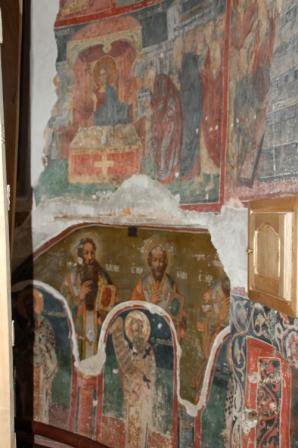
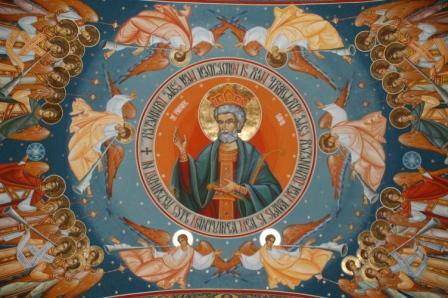
Probota (1530) is among the first Moldavian churches that has both an interior and exterior fresco painting (iconography), known as the "painted churches". This is a woman's monastery very close to the family that I stayed with (only 7k). In 1864 the monastery was closed by the Austro-Hungarians and re-opened in 1991, with restoration starting in 1996. It was here that I was first introduced to the unique Romanian church architectural & iconographic program. In the narthex it is common to see a fresco program based on the church calendar with an icon/fresco for each day of the year. I was happy to discover that my patron, the Martyr & Philosopher Justin, was depicted.
Humor Monastery 
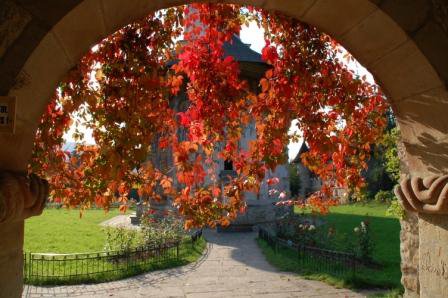
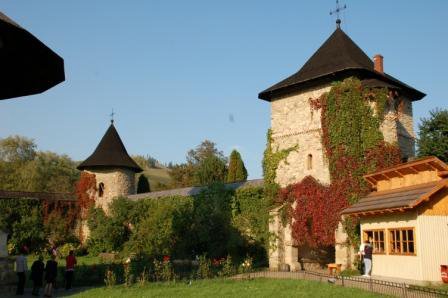
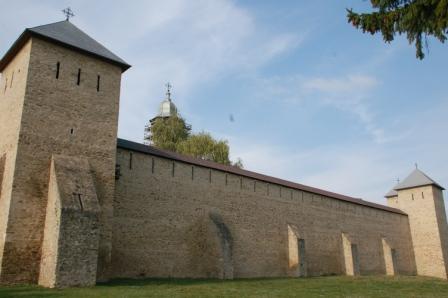
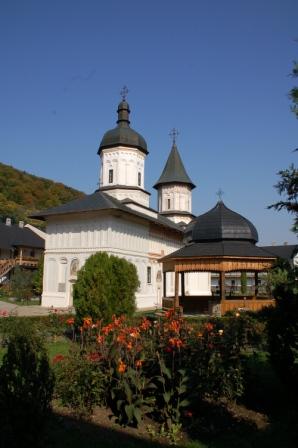
Of all Moldavia's monasteries and churches, it is Humor that exudes friendliness and tranquil charm with its predominant pink color, reflecting the character of the setting. This monastery, like many in the region, incorporated defensive necessities into the architectural program of the monastery. It has a very large tower with beautiful views of the surrounding area that gave you the feel of the times when it was built and a large defensive wall. This is also a women's monastery since the revolution. (see photo)
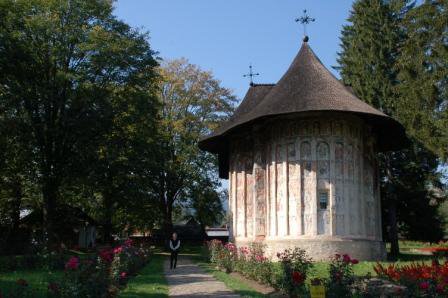
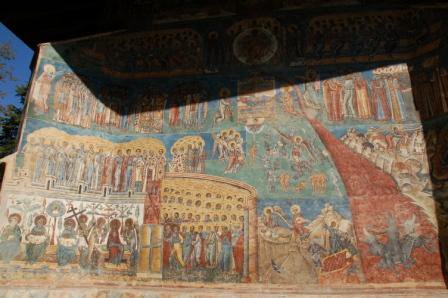
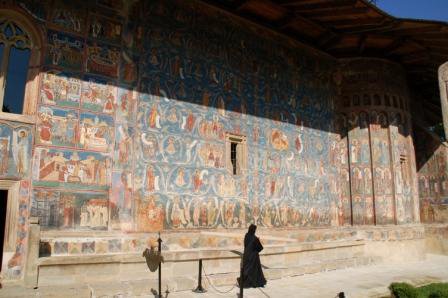
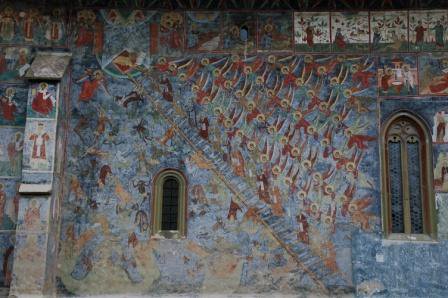
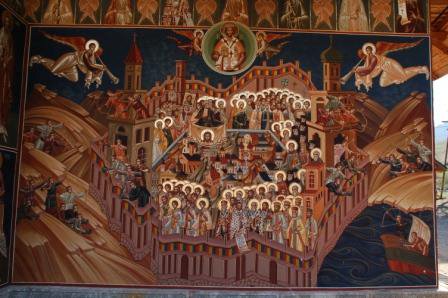
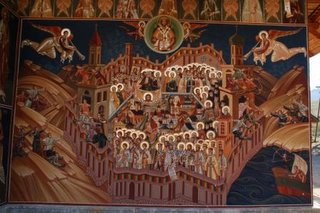
Voronet Monastery 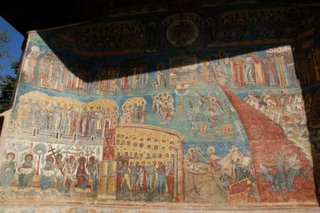 This women's monastery, a foundation of Stephen the Great, is very famous for both its interior and especially exterior painting, the latter being executed by the painter Marcu. The blue base color & emphasis is unique among any other Moldavian church, as seen in the fresco of the "Last Judgment". These (and truly sample of any of the "painted churches") could be included among the masterpieces of world arts.
Moldovita Monastery

Famous for the warmth and brilliance of its frescos, this women's monastery is the last of Peter Rares' endowments, situated on the western extremity of his realm with frescos dating from 1532 (interior) and 1537 (exterior). Of the painted churches, I liked this monasteries colors and execution the best, with its use of green.
Sucevita Monastery
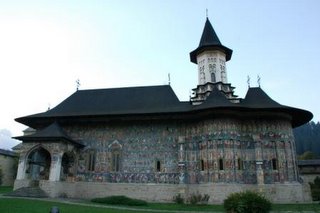
This women's monastery was established between 1581-1584 by Metropolitan George Movila, and the fresco/icon program of the interior & exterior reveal the revolution of the Moldavian painting style. It is hailed one of the best examples of the "painted churches" by most rivaling the blue of Voronet. It is situated in a beautiful valley at the beginning of the eastern slopes of the Carpathian mountains. 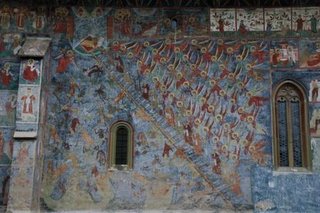
Putna Monastery
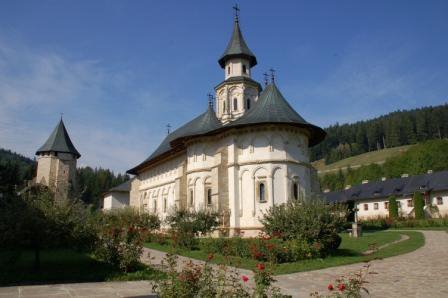
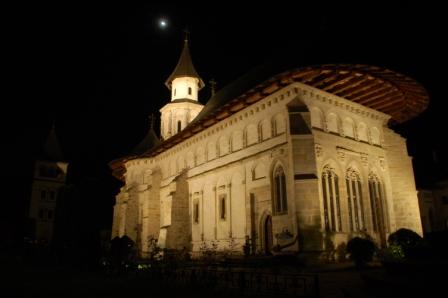
This men's monastery is hailed as the "Jerusalem of the Romanian people". It is one of the most important foundations of Stephen the Great. His tomb and that of his family are located inside the church. The monastery was an outstanding cultural center known for its copyists and miniaturists during the 15th & 16th centuries. They have a very fine collection of filigre work, wood carving, tapestry and illuminated manuscripts in their museum. We received hospitality here, and this is a truly impressive complex. 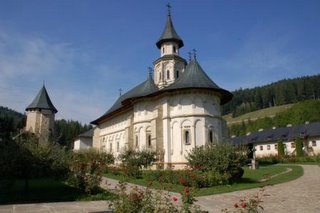 Stephen the Great built a church or monastery for every battle he won defending Moldavia from outside invaders, and his endowments are counted in the 30s...and out of humility it is said that he is buried, not where his tomb is located on the south side of the nave, but directly after the portal into the nave, so that everyone entering would walk on/over his grave. I was struck by his humility considering he was a king!
Sihastria Putnei Monastery
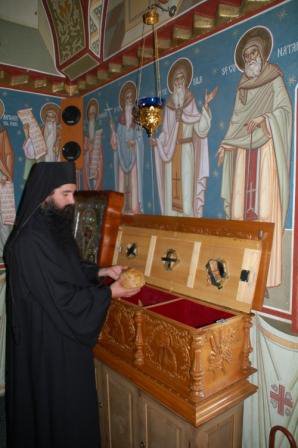
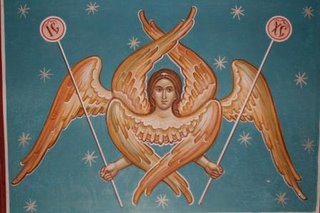 This new & thriving men's monastery is located just a couple of hundred meters from Putna and is built on the historic site of a previous ascetic establishment. We received hospitality here as well and stayed for two days, through their vigil and feast of the Veil of the Theotokos. My guide had heard good things about the Abbott there, so we took the opportunity to meet with him briefly, as well as, spent time getting to know a few of the other fathers. They were most hospitable and warm, and we concluded that this was due to the fact that they weren't on the major "tourist route" like the Putna & the "painted monasteries", used to seeing hundreds of visitors a day. They have a typikon based loosely on the Athonite tradition, but with accomodations in the service times for all of the visitors they have come for the services. They had some very special relics here as well that we venerated
 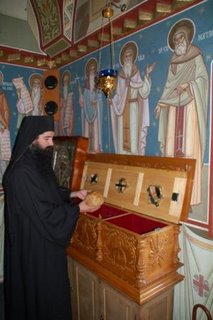 : St. Nicholas; local saints Sila, Paisie, & Nathan former hermits of the previous establishment; fragment of the True Cross; John the Baptist; Three Hierarchs Basil the Great, John Chrysostom & Gregory the Theologian; Nectarios of Aegina; Hierarch Ghenadie; Panteleimon; Monk Daniel; Martyrs of St. Savvas; Martyrs of the Sinai & Raithu monasteries; Barbara of Russia; & Anastasia the Greek. This is one of the places that I definitely want to come back to and spend more time. We really enjoyed the spirit amongst the brethren.
Dragomirna Monastery
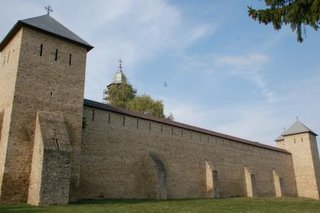
The main church at this women's monastery is the artistic creation of Anastasie Crimca, a scholar, painter, calligrapher and bishop. It mingles the Byzantine, Gothic & Moldavian styles, is much taller but shorter than any of the other Moldavian churches.
The City of Suceava
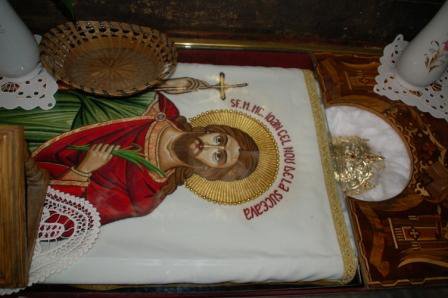
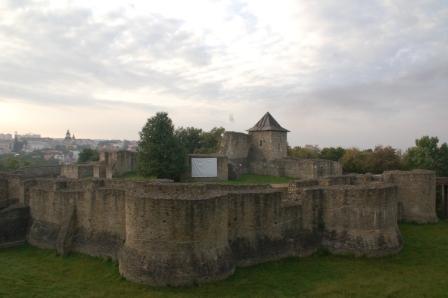
We toured through the city, stopping at a few of the old, traditional churches, and at the city cathedral containing the relics of St. John the New of Suceava. 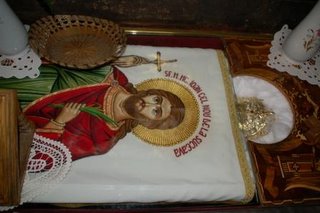 The city also boasts the largest of Stephen the Great's castles which was never defeated by outside invaders.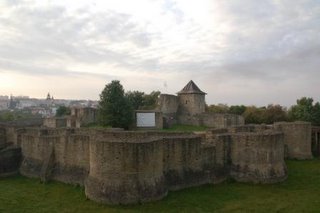
Rasca Monastery
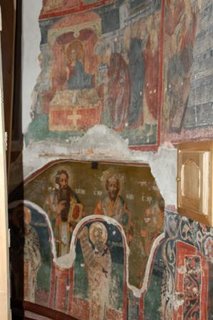 This men's monastery has recently undertaken its major fresco restoration project. This is a major undertaking for them considering that the fresco program took three different painters, with three different styles, to complete over many years resulting in both multiple layers of fresco and conflicting programs existing side by side. This can also be seen in the main church's architecture, because it also underwent several stages of construction. It is considered a treasure for art students/historians though because it chronicles the development of several different prominent styles (Byzantine, Russian & Serbian) during the period of construction (1530-50s). We received wonderful hospitality here as well and I was confronted for the first time by monks eating meat. At this monastery (as well as others in Romania) they allow those doing heavy labor to eat meat, contrary to the church canons. Also, I discovered that often times nuns will reside at the men's monasteries to help with certain duties that either there aren't enough monks or skill to handle (such as care for the guests or guest quarters, etc.) These nuns stay only for a "tour of duty", not permanently, and are considered members of their original monastic communities doing obedience to their abbess, not under the direction/obedience of the men's abbott.
Neamts County
Petro Voda Monastery (Holy Archangels)
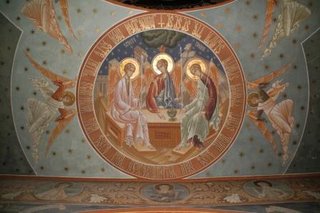
We went deeper into the Carpathian mountains to try to see and meet with the renowned Fr. Justin. He is a living martyr (like Fr. George Calciu) being imprisoned for 18 years under the communists, enduring untold difficulties and tortures in prison. He personally knew many new Romanian martyrs of the communist yoke, priests, the educated, theologians, etc. who were all rounded up and thrown in prison to try to pull Christianity up by its roots in Romania. We encountered a scene similar to that in Arizona at St. Anthony's monastery, where the faithful wait hours/days to see Elder Ephraim. Fr. Justin receives on average 100 visitors a day, at least half of which actually get to see him. Many of the demon possessed and mentally ill come here as well for Holy Unction, Exorcism, and the midnight services. We were fortunate enough to have been able to get in to speak with him before he stopped due to sheer exhaustion. He founded this monastery and they have a very beautiful church
but all other accomodations are very humble. We met some very nice monks & students very interested in American Orthodoxy & Fr. Seraphim Rose. They have the relics of four unknown hermits whose relics were uncovered in the region during the founding of the monastery.
Secu Monastery
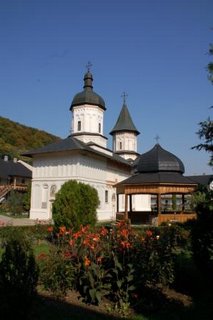 We only stayed long enough to venerate the relics at this monastery because we spent more time than we planned at Petro Voda. It is a very beautiful and picturesque men's monastery. They have these relics available for veneration: Great Martyr George, Panteleimon, Haralambos, John Chrysostom, Foot of John the Baptist (but it was stolen); Andrew the Apostle; fragment of the Holy Cross; Stephen the first martyr, Marina, Gregory the Decapolite, Apostle Philip; John the New of Suceava; and relics of the 14,000 child martyrs of King Herod.
Theodora de la Sihla Skete
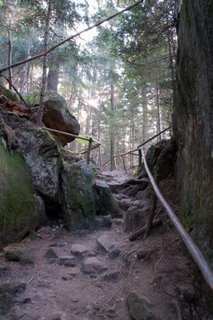
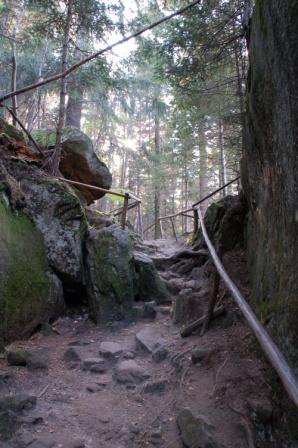
Here too at this men's skete we only stayed to venerate the relics and visit the cave of St. TheodoraWe also met a very kind monk who's the caretaker of a small church above the skete on the cliffs whom we spoke with for awhile. They have the relics of Demetrios the Great Martyr; Theodosia of Palestine; Calinic of Cernica; Modestos; Onuphrios; Tryphon the Martyr; Monk Chesarie of Athos; & Theofil the Russian Fool for Christ.
Sihastria Monastery
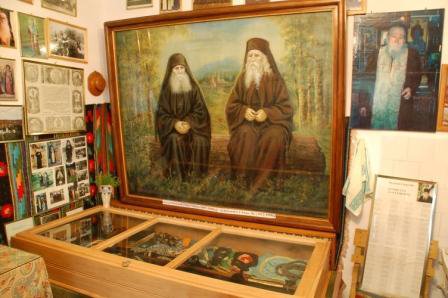
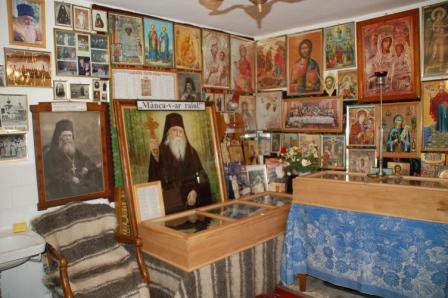
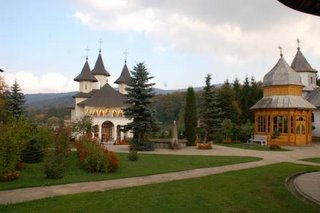 This was the home of the great contemporary Romanian elders Cleopa and his elder Paisius. When Elder Cleopa was made abbot, Sihastria was a small skete, but now it has grown into a large monastery or lavra due to the popularity of the elder during his life. We were able to visit their cells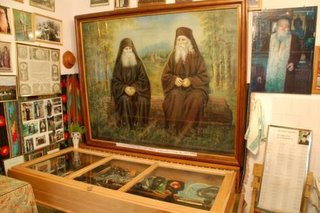
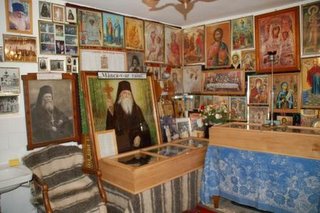 and graves. While praying and contemplating there, we met a woman who said that she was healed from a sickness by the soil from their graves! The spiritual experience here, like at Petro Voda, cannot be put into words. You could feel the holiness or maybe the presence of Elders Cleopa & Paisius there! The small chapel, which houses two very famous Romanian icons in a western style of Christ as Bridegroom (crowned with thorns, holding the reed & wearing the robe of mockery) and the Theotokos weeping & praying at the side of the Cross, amongst other very amazing old original icons from the iconostasis of the Apostles & Prophets. We tried to speak with their disciple Fr. Ioanichie Balan, the man who wrote the book on Elder Cleopa's life, but he's very ill now and wasn't receiving visitors. We did speak at length with one of the older priest monks, Fr. Antim, and had a very profitable conversation and asked for his prayers. This men's monastery is very beautiful & scenic, sitting in a valley between the peaks of the Carpathians, in thick forests. This is also a place I want to make sure to come back to spend more time at.
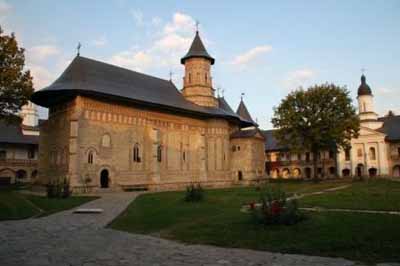
Neamt Monastery
 This men's monastery is famed for being rejuvenated by St. Paisius Velischkovski, the "man behind the Philokalia". His tomb is here, as well as, an impressive museum showing the monastery's spiritual treasures and printing press artifacts. We were able to meet with the Abbot and spend some time talking to him about the state of Orthodoxy and monasticism in particular in Romania. He also told us about an "unknown saint" whose tomb unearthed itself (literally raising to the surface & breaking through the ground) in the middle of the courtyard during the 1980s. This caused a major event because the communists tried to close the monastery and suppress word of the miracle.
 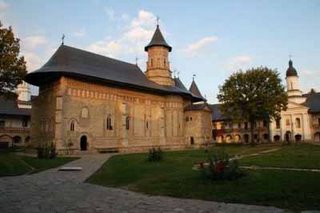 Because the monks never found the relics of St. Paisius early last century, he thinks that the unknown saint could very well be that of St. Paisius. The monastery also provides a high school seminary education for boys in an adjacent building.
Church of St. John Jacob the Hozevite 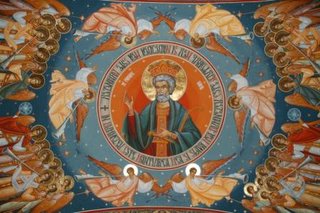
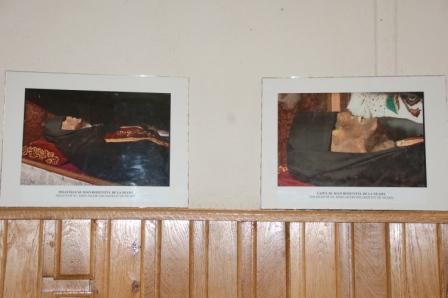
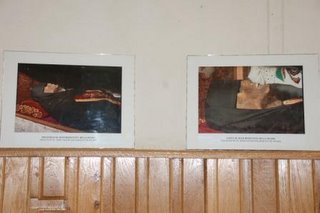
This church is dedicated to a monastic saint who reposed 30 years ago in St. Ana monastery in the Hozeva region of Israel, because he was from Neamts. It's an impressive structure for a church, but I mention it due to the quality of the frescos and photos of his incorrupt relics in Hozeva. They have been given a finger of his and are waiting to receive the complete relics for the completed church.
 Agapia Monastery
A page of Romanian history, this women's monastery is placed on a wonderful glade, surrounded by peaks covered with fir trees. Romania's greatest painter, Nicolae Grigorescu is the author of the main church interior (1858-61), the most representative creation of neoclassicism in Romania. This monastery has so many nuns that most live around the monastery structure in cottages like a village. 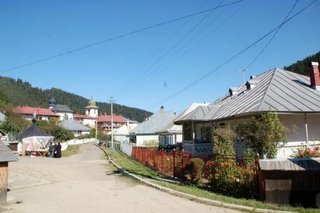 This monastery also provides high school seminary for girls, further adding to the size of the community (well over 500 including students). While Elder Cleopa was alive, he helped provide spiritual leadership to this community. They had quite a treasure of reliquary fragments from many saints of Romania, Russia & the Holy Land...so as not to repeat many already listed, I'll only list the new names: Maximus the Greek; Cucsa of Odessa, Jonah Metropolitan of Kiev, Basil of Moscow, Juliana Oshanska, Nicholas of Valaam, Anthony of Rodenezh, George the Hozevite, George of Zadonsk, Lavrentie of Chernigov, Theophil of Kitaev, Ephraim of Periaslav, Ignatius Bishop of Rostov, Marsalie of Divnagorse, Luke of Crimea, Innocent of Moscow, Philaret Met. of Kiev, Simon Bp. of Vladimir & Suzdal, Niphon of Novgorod, Martyrs of Bethlehem, Clement of Rome, Cucsa;; Theodore & Lucian & Vasile of Pecersca, Vladimir Met. of Kiev, Lavrentie Bp. of Turov, Innocent of Herson, Philaret Met. of Moscow, Ignatios of Mariupol, Pitirim of Tambov, Anthony & Ambrose & Anatolie of Optina, Macarios of Kaliazino, Theophan Zavoratul, Theofil Bp. of Novgorod, Alexy of Kiev, Job Pochaev, Antipa of Bacau, Amphilochie of Pochaev, Theodore of Zverinetz, Zosima of Alexandria, & lastly several unknown saints.
Varatec Monastery 
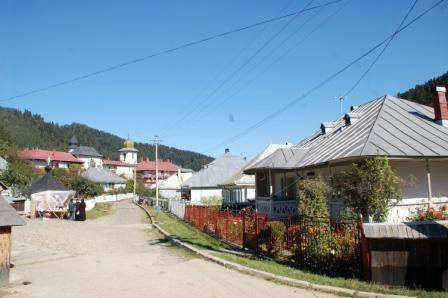
This women's monastery, possibly the largest monastic community in the world, was founded under St. Paisius Velichkovsky's guidance of Nun Olympiada in 1785. They are physically organized much like Agapia, as a village of cottages surrounding the main monastery structures. In this type of setting with so many monastics, they follow an organizational system similar to that of the Russian Lavra, where the abbess fulfills more of an administrative role and there are several spiritual mothers or mentors for all of the sisters, each nun under the guidance of one spiritual mother but also the administrative guidance of daily life by the abbess. Priests conduct the services & provide the sacrament of confession. We were able to find a nun I knew from America that would be there, finally meet in person, and discussion Orthodoxy and monasticism in particular in Romania. They also had some wonderful treasures of miracle working icons (as do most of the monasteries although I fail to mention them) and relics: fragment of the True Cross; Apostles Thomas & Simon the Zealot, Mary Magdalene; Great Martyrs George, Menas, & Theordore the Tyro; Haralambos; Longhin the Soldier; Gregory of Nyssa; Onuphrios the Great; & Xenia of Russia.
Well, I put almost all of the last two weeks it into this update...I'll have to finish about life in the village in the next couple of days...Like I said, everyone has been very warm & hospitable, very interested to hear that there's not only Orthodoxy in America, but interest in Romania. More often than not I get very surprised responses from the people I meet that I'm Orthodox (many initially think that I might be apart of another Protestant sect), and get even greater looks of shock & surprise that there is growing monasticism in America! The photos will be sent out under a seperate e-mail when I can get to a high speed connection to upload them...I've taken several hundred photos in just these first two weeks, so it might be a little time before I get them uploaded to ofoto or another photo sharing site...I just haven't had that type of online access, but I can't say that I miss it! I keep you in my thoughts & prayers and try to light candles or leave names for commemoration at every monastery we go to. Please keep me in your prayers. Tonight I head to Bucharest to see a couple of the monasteries outside of the city, then back to Iasi for the feast of St. Parascheva the New on Friday. They expect well over a million pilgrims this year because the Vatican has sent some relics of St. Paul the Apostle for the feast as well. I leave in about 10 days to head onward to the Holy Land & Sinai for hopefully up to a month. If you have any insights into current affairs in the region, they'd be appreciated. I'm going to be checking the US State Dept. website for updates & warnings, but I don't get alot of US news over here....God bless you & keep you!
Stranger in a Wonderful Land Labels: Romania